Jharia: life on top of a coal fire that has burned for 100 years
Above the ground there is life. Below it, fire. I went to Jharia and Katras in Dhanbad, Jharkhand, to see how families live on land where coal has been burning for more than a century.
 By Nitin Soni23 Nov 20267 min read
The full documentary runs 17 minutes, in Hindi. Jump to any part from the chapters below.
Hell on earth, next door to Gangs of Wasseypur
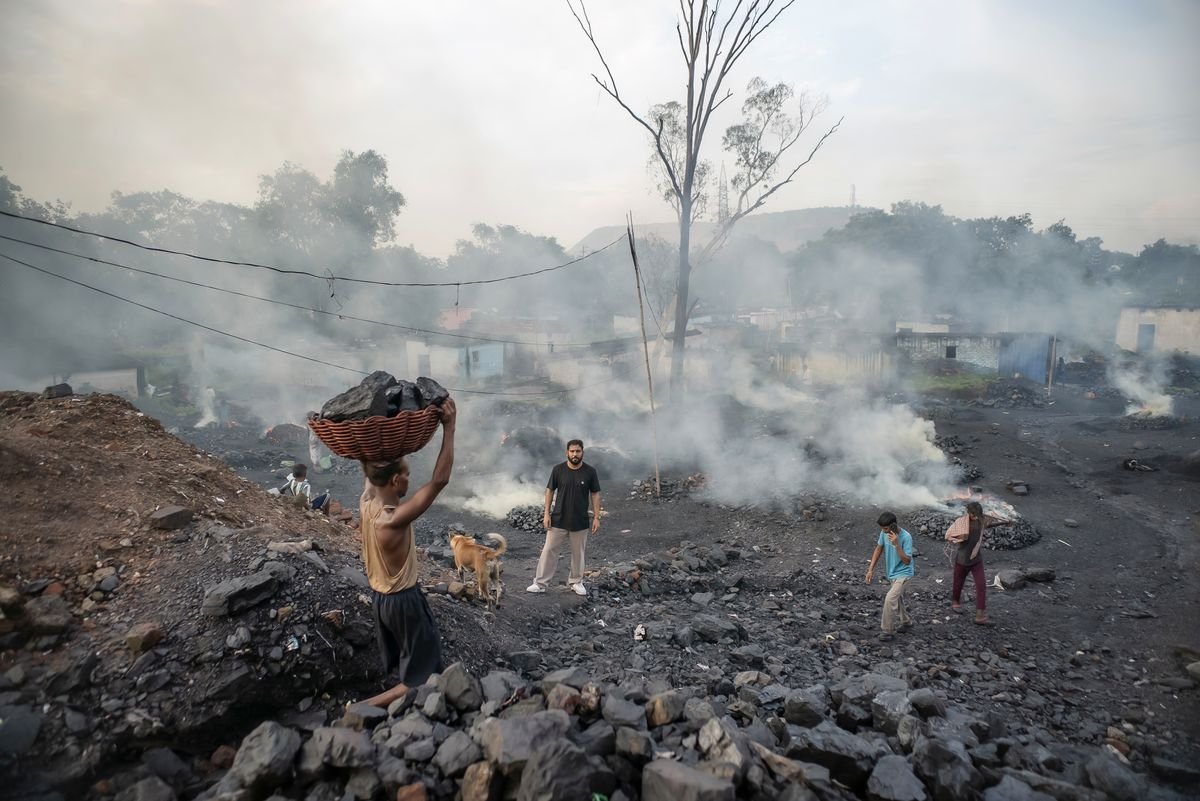
You must have seen Gangs of Wasseypur. Its story was set in Dhanbad. A short drive from Dhanbad is Jharia, and that is where I was standing when we started filming. People here call this land hell on earth. Within a few minutes, you understand why.
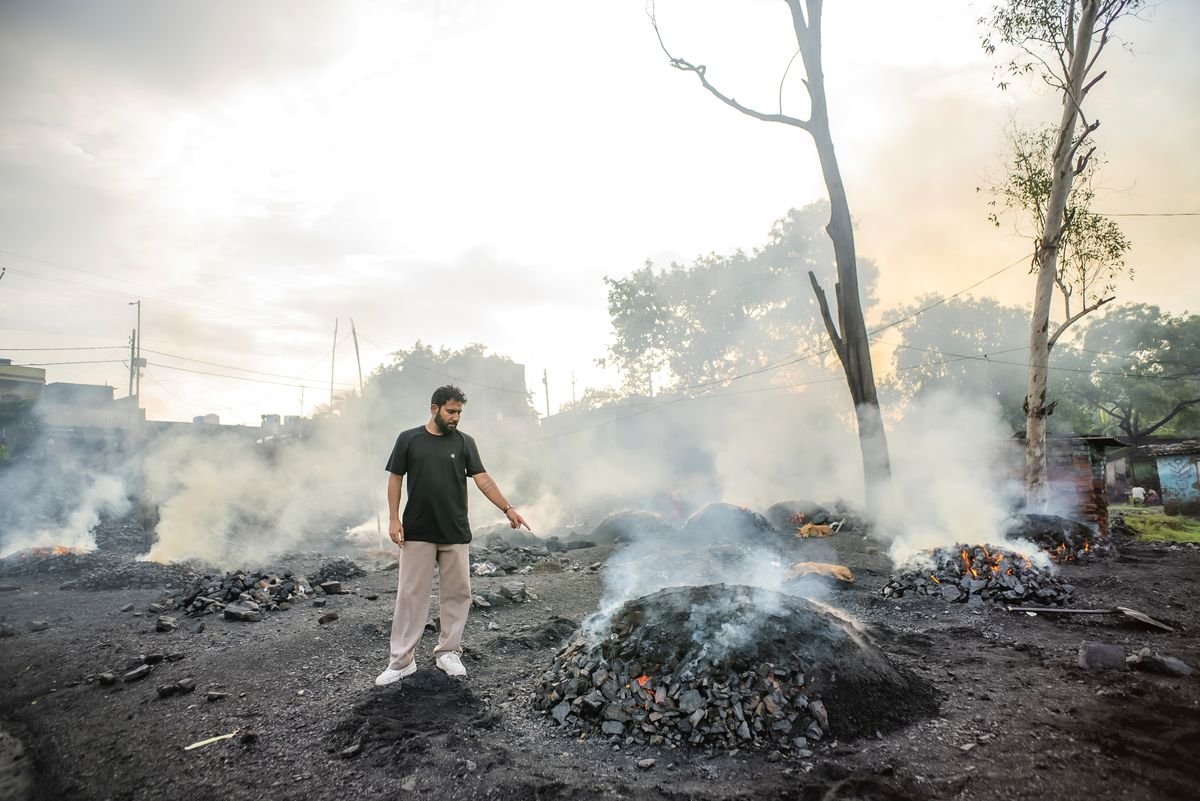
Jharia is known for coal mining. But the coal under this town is not just lying there. It is burning. Smoke comes out of cracks in the ground, and it is not one spot. The whole area looks like this.
And this fire is not new. Coal has been mined here since 1894, and the first underground fire was recorded in 1916. The Jharia coalfield holds India's only reserves of prime coking coal, the high-grade coal used to make steel. So when people say the ground has been burning for a hundred years, they are not exaggerating.
The trucks that stop for coal
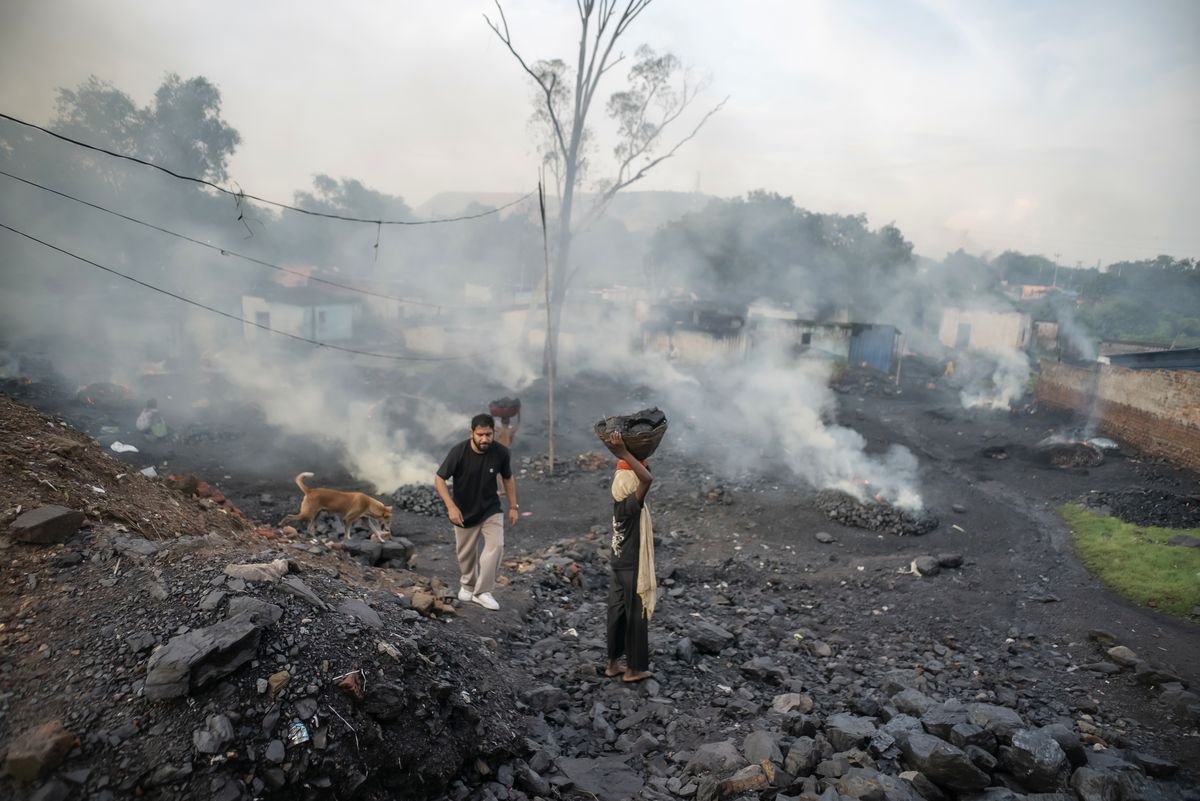
Trucks loaded with coal come out of the mines and onto the road. Then, right in the middle of the road, they stop. People climb up and pull out as much coal as they can carry.
I asked a driver why he doesn't stop them. "What can we do, sir? They force their way," he said. If a driver refuses, he told me, they beat him. The truck stops for five or ten minutes, and then it moves on.
Prem Kumar's coal kilns
Prem Kumar showed me his hands, black and rough from unloading coal. After unloading, the raw coal goes into open kilns, where it is burned, or "cooked", before it can be sold.
A sack sells for 250 to 300 rupees, he said. When I asked how many sacks they sell in a day, he said fifty. One of them said they unload about 2,000 rupees' worth of coal a day. Who else does this work? "Everyone," he said. "All my friends."
Gulgulia Patti: childhood in smoke
Right next to these burning heaps is Gulgulia Patti, where many families live. One young man told me he has lived here for fifteen years. He carries sand and cement for a living, and he has never been to school.
People who work in the mines, he said, get paid "maybe ten thousand, fifteen thousand". They live this close to the fire because this is where the work is.
I met children who had never been to school. One little boy was eating chicken feet. When I asked if all this smoke and coal dust would hurt his health, the answer was simple: "Of course it will. What can we do?"
Childhood here passes between smoke and coal. Water, electricity and health are problems of their own. After even a little rain, black water mixed with coal runs through the lanes like a river.
Malti Devi's home
Malti Devi has lived here for more than ten years, and everyone in her family does coal work. I asked her if the smoke from the kilns affects them. "If not this work, then what do we do?" she said. "Poor people eat and earn from coal."
She showed me her home and her stove. When it rains, they cover the stove with a tin sheet and keep cooking.
Katras: where houses are sinking
A few kilometres from Dhanbad is Katras. Here it is not just the land that is unsafe. People's homes are too.
We filmed there in August 2026. That month, on 6 August, land subsidence in Chhatabad, Katras, affected more than 20 houses and injured several people, according to a report by the news agency IANS. Since January, more than 45 land subsidence and sinkhole incidents had been reported across the Dhanbad coal belt.
Residents told me the ground had sunk, and they watched homes go down into it. Some blamed illegal mining underneath. Others blamed heavy blasting at a nearby mine, which they said makes the ground shake.
A young girl was crying. Since the collapse, she said, she could not go to tuition or school. "Papa built it with so much struggle," one daughter told me. "We won't let it go. Until I get a house, we're not leaving."
Imagine building a house with your whole life's savings, and then watching it sink into the ground in front of your eyes.
Why the ground sinks
A man in Katras explained it simply. About a hundred years ago, in British times, coal was dug out from under this ground through tunnels. The empty spaces were never filled back. So the ground is hollow underneath, and when there is blasting, it shakes and sinks.
Experts describe the same history. In the early days, coal here was mined in a way that left pillars of coal holding up shallow tunnels. Over time some of those pillars collapsed. That caused subsidence and cracks at the surface, and the cracks let air reach the coal underground, which helped the fires spread.
"We put all our money into this"
In one area, residents told me, around 200 houses had been emptied out of fear. One family had emptied their house just the day before. Their things were lying at other people's places. The house was cracked, and they were too scared to go inside.
Another family had put four and a half lakh rupees into their home, with no bank loan, after ten or twelve years of earning bit by bit, away from home. "Till now, not a single night of sleep," they said. "We are ruined. We have nothing left."
Inside the burning mine
Then we went to where the mines begin. You can see the fire everywhere, and you can feel it. Even standing at a distance, the heat hit me like a heat wave.
In one pit, the ground shimmered from the fire below. To show how hot it was, we put something into it, and it caught fire almost instantly.
Inside a working mine, a JCB was breaking the hill. Workers told me that everyone here, old people and children, has trouble breathing. Their management had told them the gas coming out of the coal is methane. To fight the fire, they pour water on it. It goes out, smoke rises, and then it starts burning again.
Mining here starts by breaking the hard rock above the coal. First a drill, then explosives, then excavators and tippers carry the loose rock away. The deeper they go, the more coal comes out.
What is being done
The government has a plan for Jharia. On 25 June 2025, the Union Cabinet approved a revised Jharia Master Plan to deal with fire, land subsidence and the rehabilitation of affected families, with an outlay of 5,940.47 crore rupees. It is meant to start with the most vulnerable sites, and it includes a livelihood grant of one lakh rupees for families who are moved.
Official surveys also say the area on fire has shrunk a lot: from 70 fire sites covering 17.32 square kilometres to 18 sites covering 1.8 square kilometres, according to 2021 surveys quoted by the Ministry of Coal. But as Katras shows, the ground is still giving way under people's homes.
For the key facts in one place, read my explainer: Jharia coal fire explained: why it has burned for over 100 years.
What I took back from Jharia
I came to see a burning land, but I left with much more. I saw childhoods spent in smoke, families living in the middle of it, and homes where even the ground beneath cannot be trusted. The fire here is not just burning underground. It shows in people's lives. And the question is still the same: when will this fire go out?
- Mongabay, "Living above a century-old coal fire, Jharia residents pay the price for India's mining ambitions", March 2017: mining since 1894, first fire in 1916, prime coking coal, how the pillars collapsed. Read
- IANS in The Hans India, "Jharkhand's Dhanbad coal belt on edge as subsidence incidents cross 45 in 8 months", 7 Sep 2026: the Chhatabad, Katras subsidence on 6 August 2026. Read
- Ministry of Coal (PIB), "Shri Pralhad Joshi Chairs Consultative Committee Meeting on Jharia Coalfield Master Plan", 27 Oct 2021: fire sites and area. Read
- Ministry of Coal (PIB), "Cabinet approves revised Jharia Master Plan", 25 Jun 2025: outlay, priorities and livelihood grant. Read
- Everything else in this story comes from my own documentary, filmed in Jharia and Katras in August 2026. It shows the places and people we met; it may not represent every mining area or community in the region.
Mumbai-based storyteller. Real stories, ground documentaries and current affairs on YouTube (Voice That Matters) and Instagram (@thecurlypoet).