Jharia coal fire explained: why it has burned for over 100 years
Where it is, how it started, why it is so hard to put out, why homes are sinking, and what the government is doing. The key facts, each with a source.
 By Nitin Soni23 Nov 20264 min read
I filmed in Jharia and Katras in August 2026. You can read that story here. This page answers the questions people ask most about the Jharia coal fire, using official data and news reporting. The sources are listed at the end.
- Where: the Jharia coalfield in Dhanbad district, Jharkhand. It holds India's only reserves of prime coking coal, the high-grade coal used to make steel. [1]
- Since when: coal has been mined here since 1894. The first underground fire was recorded in 1916, in the Bhowrah area. [1]
- Who runs it: Bharat Coking Coal Limited (BCCL), part of Coal India, took over the mines when coking coal mines were nationalised in 1972. [1]
- How big: 70 fire sites over 17.32 sq km at first, and 18 sites over 1.8 sq km in 2021 surveys, says the Ministry of Coal. [2]
- The plan: a revised Jharia Master Plan, approved on 25 June 2025, with an outlay of ₹5,940.47 crore. [3]
- 2026: more than 45 land subsidence and sinkhole incidents in the Dhanbad coal belt from January to early September. [4]
How did the fire start?
In the early years, miners in Jharia left pillars of coal behind to hold up shallow tunnels. Over time, some of those pillars collapsed. The ground above sank and cracked, and the cracks let air reach the coal underground. Oxygen reacts with exposed coal, the coal heats up, and fires begin. The first one was recorded in 1916. [1]
Why can't they just put it out?
These fires burn inside the coal seams, under the ground, spread across a wide area, so they are hard to reach. Inside a mine, workers showed me what they do: they pour water, the fire goes out, smoke rises, and then it starts burning again. [6]
The method the government talks about most is digging the fire out, which means excavating the burning coal. In 2021, the Ministry of Coal said work to dig out the fire had been awarded at 15 sites where it made economic sense. [2]
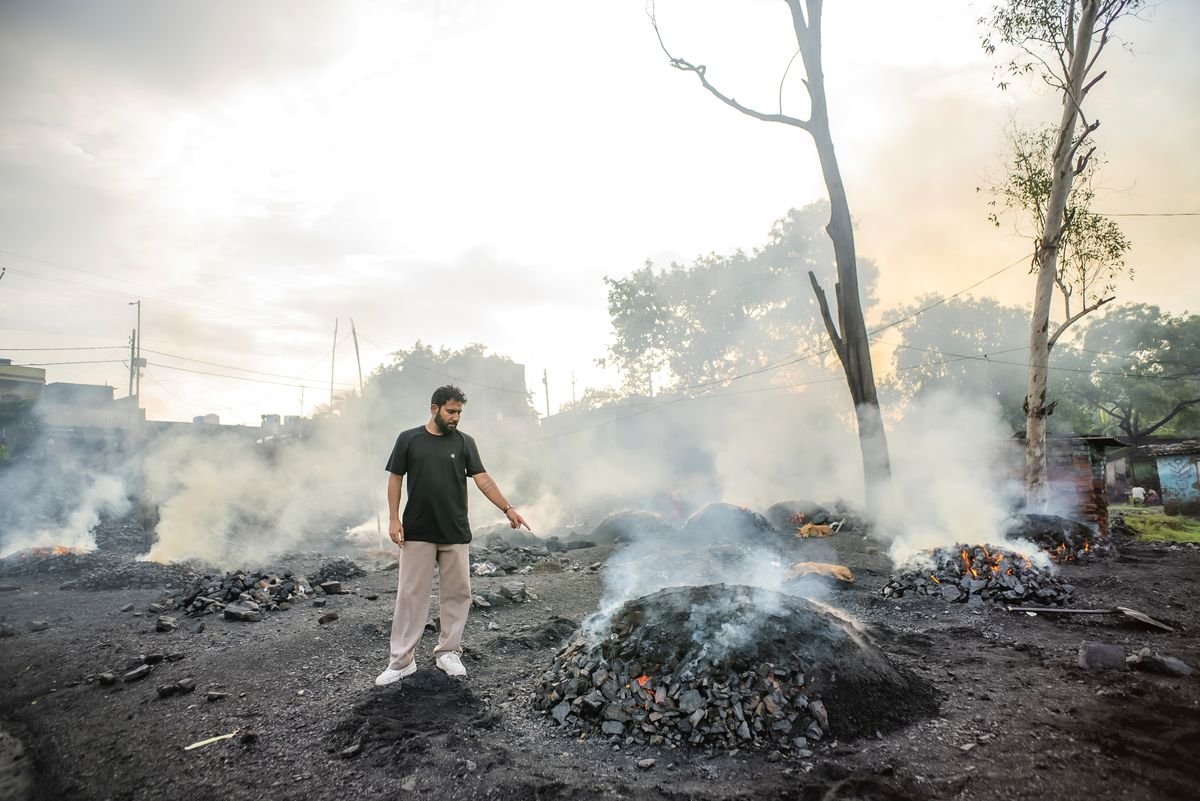
Why are houses sinking?
A century of mining left empty spaces under the ground, and the fires burn away the coal that holds the ground up. When the ground above can no longer hold, it sinks. This is called land subsidence. [1]
In Katras, residents I met blamed heavy blasting at nearby mines, and some blamed illegal mining underneath. [6] A news report on the subsidence in Chhatabad, Katras, on 6 August 2026, which affected more than 20 houses, also says residents blamed intensive blasting. The same report counts more than 45 subsidence and sinkhole incidents in the coal belt between January and early September 2026. [4]
Is it harmful to live there?
Yes. Coal fires give off smoke and gases, and mining adds dust. A mining-environment expert at the Indian School of Mines in Dhanbad told Mongabay that PM10 dust in the coal belt is three to four times above India's air quality standards. [1]
In 2019, Mongabay reported that people living near the fires suffer from breathing problems, and that some have fallen ill with tuberculosis. Govind Nath Sharma, a veteran local journalist quoted in that report, estimated that around five lakh people in Jharia and nearby areas breathe toxic gases from the fires. [5] In my film, workers told me that everyone around them, old and young, has trouble breathing. [6]
What is the government doing?
The Jharia Master Plan deals with three things: the fire, the sinking ground, and moving families out of danger. On 25 June 2025, the Union Cabinet approved a revised version with an outlay of ₹5,940.47 crore. [3]
- It works in phases, starting with the most vulnerable sites.
- Families being resettled get a livelihood grant of ₹1 lakh and access to credit of up to ₹3 lakh, whether or not they hold legal title to their land.
- It also promises skill training, and basic amenities such as roads, electricity and water.
Official surveys say the burning area has shrunk to 1.8 sq km. [2] But on the ground, people still live with smoke, cracks and the fear of the next collapse, as I saw in Katras. [6]
Watch the documentary
See it for yourself: the trucks, the kilns, the families and the mine. Read the full story with the film, or watch it on YouTube.
- Mongabay, "Living above a century-old coal fire, Jharia residents pay the price for India's mining ambitions", March 2017. Read
- Ministry of Coal (PIB), "Shri Pralhad Joshi Chairs Consultative Committee Meeting on Jharia Coalfield Master Plan", 27 Oct 2021. Read
- Ministry of Coal (PIB), "Cabinet approves revised Jharia Master Plan for dealing with Fire, Subsidence and Rehabilitation of affected families in Jharia Coalfield", 25 Jun 2025. Read
- IANS in The Hans India, "Jharkhand's Dhanbad coal belt on edge as subsidence incidents cross 45 in 8 months", 7 Sep 2026. Read
- Mongabay India, "The burning coalfields of Jharia belch poison for local residents", 3 Oct 2019. Read
- My documentary "I Survived Hell in India | Jharia's 100-Year Coal Fire", filmed in Jharia and Katras in August 2026. Watch
Mumbai-based storyteller. Real stories, ground documentaries and current affairs on YouTube (Voice That Matters) and Instagram (@thecurlypoet).